
18/05/2026

The Brazilian Supreme Court (STF) has recently brought to a close one of the most relevant and long-standing discussions involving foreign investment in Brazilian agribusiness. By unanimous decision, the Court confirmed the constitutionality of the legal restrictions on the acquisition and lease of rural properties by foreigners and by Brazilian companies controlled by foreign capital, definitively consolidating the interpretation adopted by the Attorney General Office (AGU) since 2010.
The decision directly impacts structured transactions in the agricultural sector, rural real estate investments, and corporate structures used by international groups in Brazil, ending a period marked by administrative divergences, registry-related uncertainty, and conflicting interpretations regarding the scope of the legislation.
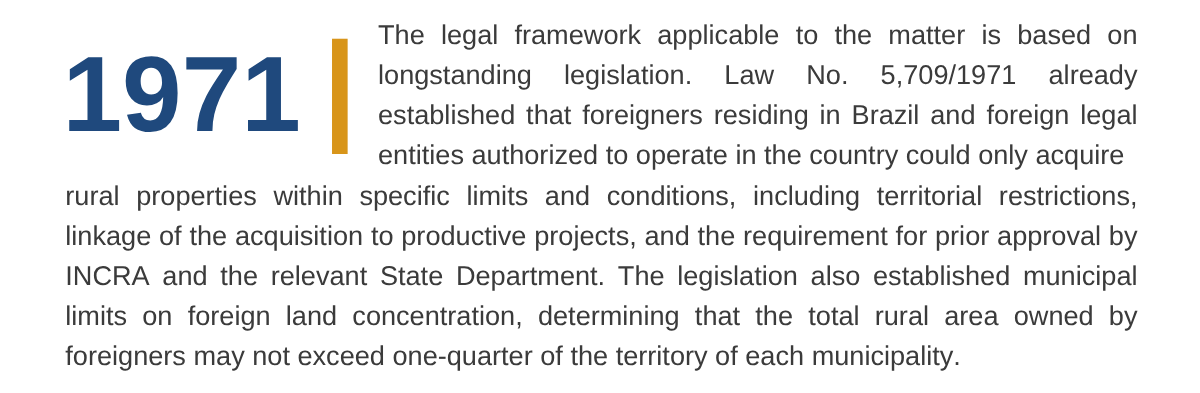
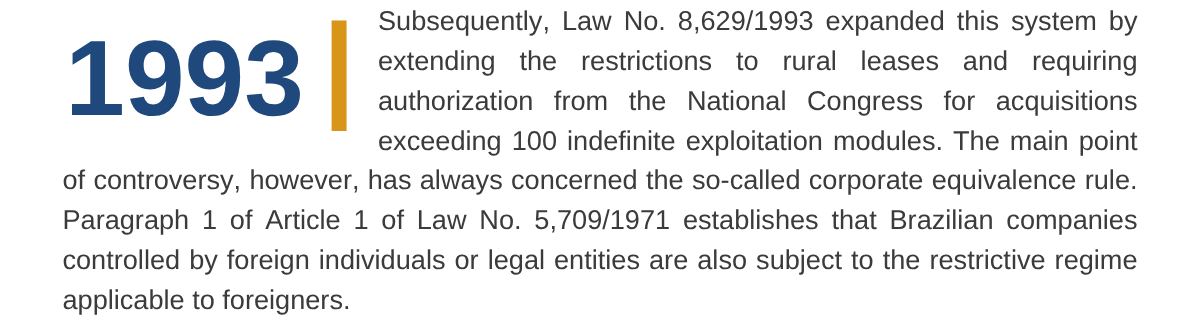
After the enactment of the 1988 Federal Constitution, the understanding that this provision had not been incorporated into the new constitutional order prevailed for more than two decades. In practice, companies incorporated under Brazilian law, even when controlled by foreign capital, operated without being subject to the restrictions of the rural land legislation.

This shift represented a turning point for the sector. The AGU’s interpretation became the basis for the actions of INCRA and real estate registry offices, once again imposing specific controls on rural acquisitions involving foreign capital.
At the same time, the issue began generating significant legal uncertainty. Divergences among administrative bodies, differing registry practices, and conflicting judicial decisions created an unstable environment for investors and market participants. In São Paulo, for example, Opinion No. 461/12-E issued by the State Court of Justice’s General Internal Affairs Office even exempted registrars and notaries from applying the restrictions.
The controversy reached the Supreme Court through ADPF 342, filed by the Brazilian Rural Society (Sociedade Rural Brasileira), and ACO 2,463, filed by the Federal Government and INCRA to ensure the uniform application of the restrictions within the registry system.
Recently, the STF definitively settled the matter. The Court dismissed ADPF 342 and upheld ACO 2,463, recognizing the full constitutionality of the restrictive regime and validating the interpretation consolidated by Legal Opinion AGU-LA-01/2010.
The Justices held that the protection of national sovereignty, territorial security, and the social function of land justify the imposition of limits and conditions on companies formally incorporated in Brazil but controlled by foreign capital. The prevailing understanding was that the legislation does not prohibit foreign investment in the rural sector, but rather establishes proportional mechanisms of control and oversight compatible with the Federal Constitution. The decision also reinforced the authority of the Federal Government and INCRA to authorize such transactions and rejected administrative interpretations that had relaxed the application of the restrictions.
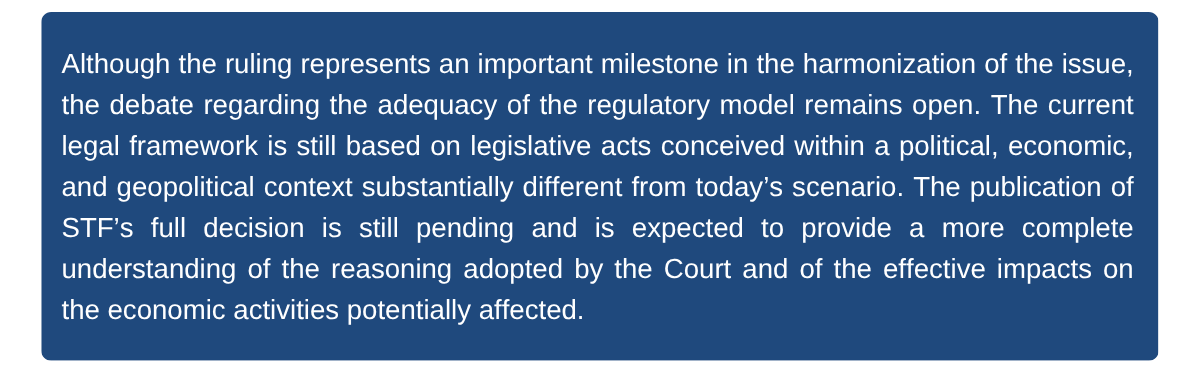
In this context, there is growing recognition that legislative modernization could provide greater predictability and legal certainty to the market, balancing the protection of national sovereignty with the need to attract productive investment to Brazilian agribusiness sector.
The Real Estate team at LO Baptista remains available to provide further clarification on the matter.
Coauthored by: Vladimir Miranda Abreu and Thiago Augusto Lopes